Chinese Supplier Sends a Partial Refund Marked “Full and Final”: Can You Claim the Balance?
現在、記事は英語と中国語で提供しています。
A partial refund from a Chinese supplier does not, by itself, answer whether the remaining claim has been released. A bank transfer labelled “full and final settlement” must be read with the parties’ negotiations, any settlement agreement, the recipient’s response and the applicable law. Conversely, the absence of a separately signed release does not guarantee that a balance remains recoverable. An email exchange or other conduct may be important evidence.
This guide concerns commercial purchases involving a Chinese supplier. It distinguishes proof that money arrived from agreement about what that money settles.
1. Identify the debt before calculating the balance
Start with the legal basis for repayment: an agreed cancellation, a valid contractual or statutory refund right, or a settlement resolving disputed performance. The original purchase price is not automatically the amount currently due. Goods retained, agreed deductions and a valid compromise can affect that calculation.
Keep separate figures for the amount originally claimed, the supplier’s admitted liability, any agreed settlement amount and payments actually received. If a buyer already agreed to accept a reduced sum in final settlement, a later reservation of rights does not automatically restore the original demand. If only payment dates changed, the outstanding principal and other claims may remain, subject to the actual terms.
For an agreed repayment schedule, see supplier refund instalments and settlement terms.
2. Read the transfer remark together with the surrounding communications
| Document or event | What needs checking |
|---|---|
| Supplier inserts “full and final” in a transfer remark | Was that condition agreed beforehand, or is it a new assertion by the payer? |
| Buyer confirms that money arrived | Does the message acknowledge only the receipt, or also agree that the dispute is closed? |
| Buyer signs a receipt or clicks an acceptance button | Does the wording include a waiver, release, withdrawal or settlement of other orders? |
| Earlier email or settlement agreement specifies a reduced sum | When does the release take effect, and is it conditional on full and timely payment? |
Retain the complete message thread, attachments and versions. A cropped screenshot showing only “received” may omit the offer being answered. Identify who responded and whether that person had authority to settle the company’s claim. An accounting entry and a legal release should not be treated as interchangeable without examining their context.
3. Where Chinese domestic law applies, distinguish modification from debt remission
Under Articles 140 and 142 of the Civil Code, intention may be expressed through words or conduct; silence has legal significance only in specified circumstances, including an applicable agreement or established dealings. Context matters when interpreting a statement. Article 466 applies interpretation rules to disputed contract wording.
Articles 543 and 544 address agreed contract changes and uncertainty about their content. Article 575 separately addresses a creditor’s remission of debt, subject to the debtor’s right to refuse within a reasonable period. Therefore, the analysis is not confined to finding a document signed by both parties. It must also ask whether the buyer made an effective release and what it covered. A supplier’s own description of a payment is not a substitute for that analysis.
Sources: Civil Code, General Provisions and Civil Code, Contracts. The Code took effect on 1 January 2021. The governing law and rules for older events require separate checking.
4. Check the CISG and any separate settlement law
For an international sale governed by the United Nations Convention on Contracts for the International Sale of Goods (CISG), Article 8 directs attention to intention and relevant circumstances. Article 18 states that silence or inactivity alone is not acceptance. Article 29 addresses modification or termination by agreement, including a written-modification clause and the effect of reliance on a party’s conduct.
These provisions do not justify assuming that every refund settlement is governed entirely by the CISG. Check the Convention’s scope, any exclusion, the applicable declarations and form requirements under Articles 12 and 96, and whether a separate settlement raises issues governed by domestic law. The supplier’s location alone does not settle those questions.
The treaty entered into force on 1 January 1988. See the official reproduction of the CISG in the Canadian legislation’s schedule and the UN depositary status record. The Canadian implementing legislation is not presented here as the governing law of a China dispute.
5. Respond accurately and keep a payment reconciliation
If no final compromise has already been agreed, a receipt acknowledgment can identify the actual amount, currency, value date and order, state that the buyer disputes the proposed release, and specify which balance or other claims remain in dispute. Address a proposed condition before accepting it where possible. A generic “all rights reserved” sentence is not a reliable way to undo an existing agreement or make inconsistent conduct harmless.
If money has already arrived, preserve the bank advice and the complete negotiations before deciding what to do next. Neither automatically returning it nor silently treating it as unconditional is a universal solution. Review the settlement terms and the governing law promptly.
Reconcile gross remittance, net credit, bank charges and allocation to particular orders. Assess interest and other refund-related claims separately, avoid double recovery, and check whether any release includes costs, quality claims or other contracts. A credit note also needs separate analysis; it is not proof that cash was received.
6. Prepare a focused review of the remaining claim in China
For an initial review, prepare the contract and dispute-resolution clause, supplier’s exact legal name, original payment proof, basis for cancellation or refund, all settlement proposals, the disputed receipt wording and a dated payment table. Identify any court, arbitration or platform deadline. An initial inquiry does not suspend a legal deadline.
Contact Lawyer Pan or email panjianxing46@gmail.com with a short chronology, the amount disputed and the supplier’s location. Possible work includes reviewing the release issue, identifying the proper debtor, preparing a demand and assessing agreed arbitration or litigation and recovery in China. The appropriate route, scope of work and fees need confirmation before engagement; this article promises no recovery or result. See cross-border trade dispute services.
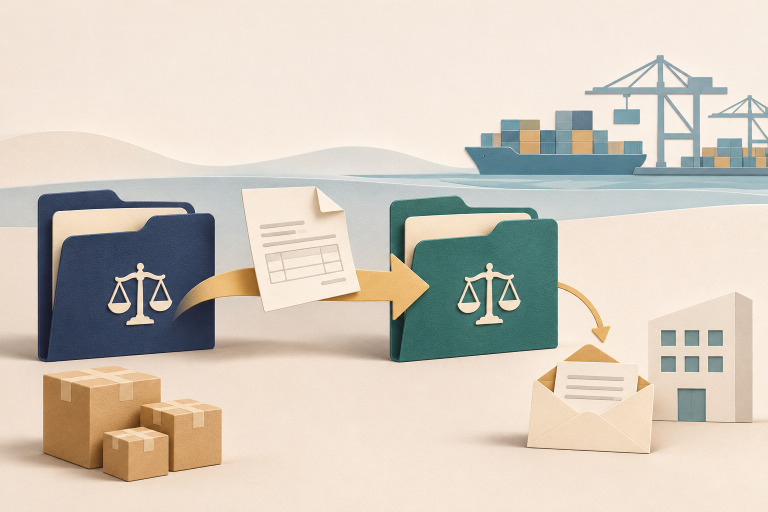
General information, checked on 6 November 2026. No real client or case outcome is described. Cover: AI-generated conceptual illustration, not a real case photograph.
Author: Jianxing Pan
Partner, Beijing ChangAn Law Firm; working in Beijing and Shenzhen.